Why The Goodday Script Elevates Professional and Personal Design Projects
In the landscape of digital typography, finding a typeface that balances legibility with genuine personality is often a challenge. Many designers struggle to find scripts that do not feel forced or overly decorative. The Goodday stands out in this crowded market because it delivers on its promise: a stylish and incredibly elegant script font that feels authentic rather than artificial. It is designed for those who need a handwritten touch without sacrificing the structural integrity required for professional work.
This font is not merely a collection of connected letters; it is a tool for communication. Whether you are designing a high-end wedding invitation or a minimalist logo for a boutique brand, the visual weight and flow of The Goodday can transform a standard layout into something memorable. Its ability to mimic natural handwriting while maintaining consistency makes it a versatile asset for creators who value precision alongside artistic flair.
Defining the Aesthetic and Core Characteristics
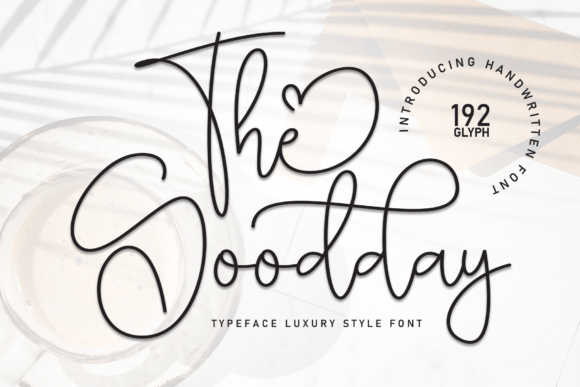
To understand the utility of The Goodday, one must first look at its visual DNA. Unlike rigid block fonts, this script features fluid connections and varying stroke widths that suggest the movement of a pen across paper. The elegance lies in its subtlety; it does not scream for attention but rather invites the viewer to lean in and read.
- Natural Flow: The letterforms connect in a way that mimics cursive writing, creating a continuous rhythm that guides the eye smoothly from left to right.
- Elegant Curves: The terminals and swashes are refined, avoiding the excessive flourishes found in more theatrical scripts. This restraint ensures the text remains readable even at smaller sizes.
- Professional Tone: While it is decorative, it avoids looking childish or dated. It carries a sophistication that aligns well with modern branding standards.
These characteristics make it particularly effective when used as a display font. When paired correctly with a clean sans-serif or serif body text, The Goodday acts as a powerful focal point, adding a layer of human connection to otherwise sterile designs.
Practical Applications Across Industries
The versatility of The Goodday allows it to serve a wide range of functional needs. Its primary strength lies in contexts where personalization and warmth are paramount. For instance, in the event planning industry, it has become a go-to choice for wedding invitations. The script's elegance conveys formality and celebration simultaneously, setting the right tone before the guest even opens the card.
Beyond events, the font proves highly effective for thank you cards and greeting cards. In an era dominated by digital communication, physical mail requires extra effort to stand out. Using The Goodday on these materials adds a tactile quality that feels sincere and thoughtful. It bridges the gap between a typed message and a hand-written note, offering the best of both worlds.
For marketers and small business owners, the application extends to logos and business cards. A logo set in The Goodday can instantly communicate craftsmanship, artistry, or a premium service level. Consider a freelance photographer, a florist, or a boutique coffee shop; the script suggests that the business owner cares about details and offers a personalized experience. However, success here depends on balance. The font should be used for the brand name, while supporting information like contact details should remain in a neutral typeface to ensure clarity.
Evaluating Usability and Technical Performance
From a technical standpoint, the quality of a font is measured by its usability in real-world scenarios. Does it hold up when scaled? Are the kerning pairs balanced? Does it render consistently across different operating systems and devices?
The Goodday demonstrates strong reliability in these areas. Because it is designed with a specific aesthetic goal, the character spacing (kerning) is generally handled well, preventing awkward gaps between letters that can disrupt readability. When used in print design, such as on business cards or flyers, the ink distribution appears consistent, ensuring that the delicate strokes do not break up or disappear during the printing process.
In digital environments, the font performs effectively on screens ranging from mobile devices to large desktop monitors. Its curves are defined clearly enough to prevent blurring on high-resolution displays, which is crucial for maintaining the "handwritten" illusion. However, users should be mindful of contrast ratios. As a script, some of the thinner lines may vanish against light backgrounds or complex images. Testing the font against various background colors is a necessary step in the design workflow to guarantee accessibility and visibility.
Flexibility in Workflow and Integration
One of the significant advantages of using The Goodday is its flexibility within creative software. Whether you are working in Adobe Illustrator, Photoshop, Canva, or other design platforms, the font integrates seamlessly. It supports standard OpenType features, allowing for stylistic alternates if available, which can further customize the look of the text to fit specific project requirements.
This flexibility is vital for freelancers and agencies who manage multiple projects with different client needs. Instead of searching for five different scripts to achieve a "handwritten" look, a single license of The Goodday can cover most requirements. It reduces the time spent sourcing assets and allows the designer to focus on layout and composition. The consistency of the font family ensures that a brand identity remains cohesive across all touchpoints, from social media graphics to printed collateral.
Strategic Fit: Who Benefits Most?
Determining whether The Goodday fits your specific needs requires an honest assessment of your project goals and audience. This font is not a universal solution, but it is an excellent match for specific user profiles and situations.
- Wedding Planners and Stationery Designers: For professionals creating custom invitations, the script's elegance is unmatched. It provides the romantic and formal atmosphere that couples expect without requiring expensive calligraphy services.
- Small Business Owners and Entrepreneurs: If you run a lifestyle brand, a bakery, or a creative studio, this font helps establish a personal connection with customers. It signals that there is a human behind the business, which builds trust and loyalty.
- Content Creators and Bloggers: Visual content is king in the current digital ecosystem. Using The Goodday for headers, pull quotes, or social media overlays can elevate the perceived value of your content, making it look more polished and professionally curated.
- Educators and Publishers: For materials that require a friendly yet authoritative tone, such as educational worksheets or book covers for fiction, the script adds a narrative element that engages the reader.
However, there are limitations to consider. The Goodday is not suitable for long blocks of text. Scripts are inherently difficult to read in paragraph form due to the variation in letter shapes and the lack of uniform line height. Using it for body copy will likely result in poor user experience and reduced comprehension. It is strictly a display font intended for headlines, titles, and short phrases.
Long-Term Value and Conclusion
When evaluating the long-term value of any design asset, durability and trend-resistance are key factors. Trends in typography cycle rapidly, often moving from bold geometric sans-serifs back to retro scripts every few years. The Goodday possesses a timeless quality that anchors it in the classic tradition of elegant handwriting. This means it is less likely to look dated in a year or two compared to fonts that rely heavily on fleeting stylistic gimmicks.
For professionals seeking to enhance their portfolio or their clients' brands, investing in a high-quality script like The Goodday is a practical decision. It offers immediate visual impact while maintaining the structural soundness needed for professional execution. By understanding its strengths and respecting its limitations, designers can leverage this font to create work that feels both sophisticated and deeply human.
Ultimately, the effectiveness of The Goodday comes down to context. When applied thoughtfully to wedding invitations, thank you notes, logos, or marketing materials, it transforms the mundane into the memorable. It serves as a reminder that even in a digital-first world, the warmth of a handwritten style holds significant power. For anyone looking to add a touch of class and authenticity to their visual communications, this font represents a reliable and valuable resource.