Complaint: A Bold Typeface for High-Impact Communication
In a digital landscape saturated with uniform sans-serifs and decorative scripts, finding a typeface that commands immediate attention without sacrificing legibility is a persistent challenge. Complaint emerges as a striking solution for designers and creators who need to assert authority in their visual hierarchy. This bold and confident letterform family is not merely a font; it is a deliberate design choice intended to disrupt the status quo of standard typography.
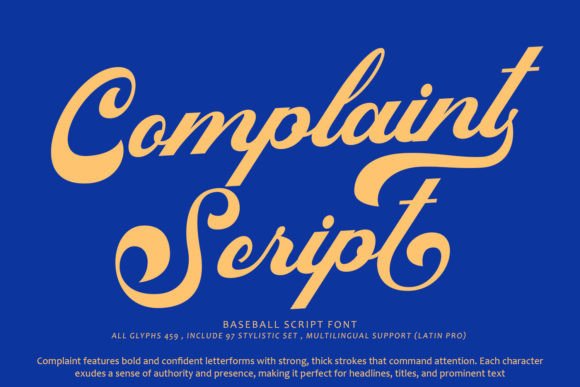
The core philosophy behind Complaint rests on its ability to project presence. Every character is constructed with strong, thick strokes that create a visual weight impossible to ignore. Unlike many display fonts that rely on gimmicks or excessive ornamentation to stand out, Complaint derives its impact from structural integrity and geometric confidence. It speaks directly to the viewer, demanding they stop scrolling and engage with the message. For professionals seeking to elevate headlines, titles, and prominent text, this typeface offers a distinct advantage in an environment where attention is the most scarce commodity.
Defining the Visual Identity
When evaluating Complaint, one must first look at its fundamental architecture. The letterforms are characterized by their substantial mass and unwavering verticality. The strokes are thick, yet they maintain a surprising degree of openness in the counters (the enclosed spaces within letters like 'o' or 'e'). This balance prevents the text from feeling muddy or illegible, even when rendered at smaller sizes or viewed on lower-resolution screens.
The aesthetic is undeniably assertive. There is a sense of urgency in the way the characters sit on the baseline. They do not waver or lean; they stand firm. This stability translates into a perception of reliability and strength. In a market where brands often struggle to differentiate themselves through tone alone, Complaint provides a visual shorthand for confidence. It suggests that the content it frames is important, urgent, and worthy of scrutiny.
- Thick Strokes: The heavy line weights provide immediate visual dominance.
- Geometric Precision: Clean lines and consistent curvature ensure a modern feel.
- High Contrast: While primarily a bold face, the interplay between thick stems and thinner details creates dynamic rhythm.
- Authoritative Tone: The design inherently communicates leadership and decisiveness.
Practical Application in Professional Workflows
The true value of Complaint lies in its versatility across various media platforms. For entrepreneurs and small business owners, the primary use case often involves marketing materials where conversion rates depend on capturing interest quickly. Whether used on a landing page hero section, a social media banner, or a printed brochure, the typeface ensures that the headline cuts through the visual noise.
Consider the scenario of a freelancer pitching a proposal. Standard fonts can sometimes make a document feel generic or passive. By incorporating Complaint for key headings or pull quotes, the freelancer introduces a layer of professional gravitas. It signals to the client that the work presented is backed by serious intent. Similarly, for educators and publishers, this font serves as an excellent tool for emphasizing critical concepts or chapter titles in educational materials, ensuring that students or readers identify the most vital information instantly.
The flexibility of Complaint extends beyond just bold variations. While the name implies a singular intensity, effective usage often involves pairing it with lighter, more neutral typefaces. This contrast creates a sophisticated typographic hierarchy. Using a clean, understated sans-serif for body copy allows the boldness of Complaint to shine without overwhelming the reader. This combination balances authority with readability, a crucial factor for long-form content such as blog posts, articles, or white papers.
Performance in Real-World Scenarios
Testing Complaint in live environments reveals its strengths and potential limitations. On large-format displays, such as billboards or conference backdrops, the typeface performs exceptionally well. The thick strokes hold up under pressure, maintaining clarity even from a distance. However, in very dense blocks of text, its heavy nature can become fatiguing if overused. This is not a flaw but a characteristic of its design; it is meant to be a spotlight, not a floodlight.
For digital interfaces, the rendering quality is generally high. The curves are smooth, and the terminals are crisp. When applied to mobile devices, the large x-height ensures that the text remains legible despite the limited screen real estate. Marketers will find that buttons or call-to-action (CTA) labels set in Complaint tend to attract higher click-through rates compared to standard UI fonts, simply due to the increased visual salience.
However, consistency is key. Because the font is so dominant, using it inconsistently—such as switching between different weights or styles arbitrarily—can undermine its effectiveness. To maximize the utility of Complaint, users should establish a strict style guide that defines exactly where and how the typeface appears. This disciplined approach ensures that the "bold statement" remains a coherent part of the brand identity rather than a chaotic distraction.
Audience Fit and Strategic Considerations
Who benefits most from integrating Complaint into their toolkit? The answer depends largely on the goals of the project and the desired emotional response from the audience.
- Brands Seeking Disruption: Companies in competitive industries like technology, finance, or fashion often need to break through market saturation. Complaint provides the edge needed to appear innovative and daring.
- Content Creators: Bloggers and YouTubers looking to build a personal brand can use this font to establish a signature look that feels authoritative and trustworthy.
- Event Organizers: For conferences, workshops, or product launches, the typeface excels in creating posters and promotional materials that convey excitement and importance.
- Educational Institutions: Schools and training centers can utilize it to highlight key learning outcomes or safety protocols, ensuring these messages are never missed.
Conversely, there are situations where Complaint may not be the optimal choice. If the goal is to evoke softness, intimacy, or traditional elegance, this font might feel too aggressive. It is less suitable for luxury brands that rely on subtlety and refinement, or for contexts requiring a friendly, approachable tone. Understanding the emotional resonance of a typeface is as important as understanding its technical specifications.
Quality and Long-Term Value
From a production standpoint, Complaint demonstrates high-quality craftsmanship. The kerning pairs are generally well-balanced, reducing the need for manual adjustments in layout software. The file formats provided typically include support for multiple languages and special characters, which is essential for global projects. This attention to detail reflects a commitment to usability that saves time during the design process.
Regarding longevity, trends in typography shift rapidly, but the principles of bold, clear communication remain constant. Complaint is rooted in functional design rather than fleeting stylistic fads. While its specific aesthetic is trendy, its underlying function—commanding attention—is timeless. This makes it a valuable asset for any designer's library, capable of serving projects for years to come.
Ultimately, the decision to adopt Complaint should be driven by a clear understanding of the message you wish to convey. If your objective is to inform, persuade, or inspire action with a voice that cannot be ignored, this typeface offers a robust foundation. It transforms static text into a dynamic element of design, bridging the gap between information and impact. For those willing to leverage its power responsibly, Complaint represents a significant upgrade in visual communication strategy.