Miracles Duo Font Evaluation
In the landscape of digital typography, finding a typeface that balances structural integrity with organic expression remains a persistent challenge. Miracles Duo emerges as a specific solution to this problem, offering a dual-font system designed to replicate the nuances of hand-written communication without sacrificing legibility. This resource consists of two distinct but harmonious components: an elegant script font and a complementary sans serif typeface. The primary objective behind its creation was to capture the peculiarities of handwriting, ensuring that each letter possesses a unique character and that combinations of letters maintain a sense of individuality.
For designers, brand managers, and content creators evaluating font pairs, understanding the mechanics of this duo is essential. Unlike standard ligature systems where characters are mechanically linked, Miracles Duo attempts to simulate the fluidity of ink on paper. This evaluation explores the functional capabilities, aesthetic tradeoffs, and practical applications of this modern and expressive pair to help determine if it aligns with specific project requirements.
Core Composition and Design Philosophy
The foundation of Miracles Duo lies in its duality. The inclusion of both a script and a sans serif font allows for versatile application, yet the true value proposition is how these elements interact. The script component is not merely a decorative overlay; it is constructed to reflect the irregularities found in natural handwriting. Each letter is designed to be special, avoiding the rigid uniformity often seen in digital scripts.
When paired with the sans serif element, the combination creates a sense of lightness and delicacy. The sans serif acts as an anchor, providing the necessary structure to ground the more whimsical script. This balance prevents the design from becoming unreadable or overly chaotic. The philosophy behind the design suggests that while digital fonts are efficient, they often lack the human touch. Miracles Duo addresses this by incorporating unique letter combinations that mimic the subtle variations of a pen moving across a page.
Practical Applications and Use Cases
Evaluating where this font pair fits best requires looking at industries and projects that prioritize emotional connection and visual elegance. The versatility of using each font separately or together opens several avenues for implementation:
- Print Media: The delicate nature of the script makes it highly suitable for greeting cards and invitations. The contrast between the handwritten feel of the script and the clean lines of the sans serif creates a sophisticated hierarchy that guides the reader's eye effectively.
- Branding Materials: For brands seeking a personal, artisanal, or boutique identity, this duo offers a way to convey approachability. Logos, business cards, and packaging can benefit from the "hand-crafted" aesthetic that Miracles Duo provides.
- Apparel and Merchandise: T-shirt designs often require text that stands out while maintaining readability. The expressive quality of the script allows for creative layouts that feel less manufactured and more authentic.
- Digital Content: Quotes, social media graphics, and blog headers can utilize the font to add a layer of intimacy to digital spaces, which are typically dominated by rigid geometric fonts.
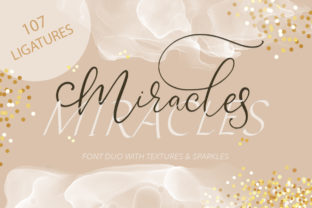
Additionally, the package includes 10 high-resolution ink shapes with perfect transparency and 6 glitter extras. These bonus assets serve a functional purpose beyond mere decoration. They allow users to create texture and depth without leaving the ecosystem of the font family. For example, an ink shape can be used as a background element to frame a quote, while the glitter extras can highlight key words in a poster design.
Benefits of the Miracles Duo System
There are distinct advantages to selecting this specific font duo over generic alternatives. The most significant benefit is the cohesion provided by the shared design DNA. Because the script and sans serif were created to work together, there is no need for extensive tweaking of weights, spacing, or alignment. This saves time during the design process.
Furthermore, the emphasis on unique letter combinations reduces the risk of repetitive patterns. In many commercial scripts, certain letter pairs look identical regardless of context. Miracles Duo aims to break this pattern, resulting in text that feels more dynamic and engaging. The ability to use the fonts independently also adds to their utility. A designer might choose to use only the sans serif for body copy while reserving the script for headlines, or vice versa, depending on the message being conveyed.
Tradeoffs and Considerations
While the aesthetic appeal is clear, potential users must consider the limitations inherent in this style of typography. The very features that make the script expressive—its irregularity and hand-written qualities—can pose challenges for accessibility and long-form reading. The font is not designed for dense blocks of text. Using the script for paragraphs would likely reduce readability and cause eye strain.
Another consideration is the specific nature of the "hand-written" effect. While the goal is to repeat the peculiarities of handwriting, some users may find that the execution leans too heavily into a stylized look rather than a truly natural one. If a project requires a raw, unpolished aesthetic, this font might appear too refined. Conversely, if a client demands a strictly corporate or minimalist look, the delicacy of the script could be perceived as too informal or fragile.
The bonus assets, such as the glitter and ink shapes, require careful handling. While they add value, overusing them can clutter a design and detract from the core message. It is important to integrate these elements strategically rather than as default decorations.
Alternatives and Comparative Analysis
Designers should evaluate whether Miracles Duo is the optimal choice compared to other options in the market. If the primary goal is maximum legibility for technical documentation or data-heavy interfaces, a neutral sans-serif or a dedicated typewriter-style font would be a stronger fit. Similarly, for projects requiring a bold, authoritative voice, a heavy slab serif or a condensed grotesque might be more appropriate than the light and delicate Miracles Duo.
However, for projects specifically targeting lifestyle, wellness, fashion, or creative arts sectors, the competition is different. Many available script fonts lack the accompanying sans serif that complements them perfectly. In these scenarios, the integrated nature of Miracles Duo offers a distinct advantage over mixing and matching disparate fonts from different families.
Decision-Making Insights
To determine if Miracles Duo aligns with your goals, ask yourself the following questions regarding your project needs:
- Is the tone intimate? Does the project require a feeling of personal connection or handmade quality? If yes, the script component is a strong candidate.
- What is the volume of text? Will the font be used for short headlines and accents, or will it carry the bulk of the information? If the latter, rely on the sans serif component.
- Do you need a complete system? Are you looking for a ready-made pairing that eliminates the guesswork of font selection? The duo format simplifies this decision.
- Are textures required? Do you need built-in assets like ink splashes or glitter effects to enhance the visual narrative without sourcing external graphics?
If the answer to these questions points toward a need for elegance, expressiveness, and a cohesive visual language, Miracles Duo presents a compelling option. However, if the priority is strict minimalism, high-volume readability, or a purely industrial aesthetic, alternative resources should be explored. Ultimately, the success of this font duo depends on its judicious application within a broader design strategy.